In 2026, I Finally Gave Up Traditional CAD Translation Plugins
As an engineer who has been working in the architectural design industry for over a decade, I have witnessed the evolution of CAD translation workflows from completely manual to semi-automated processes. Whenever we received international projects, drawing translation always caused headaches for the entire team. Until 2026, I finally made the decision to completely say goodbye to those traditional CAD translation plugins and embrace a brand new AI intelligent translation solution. This shift is not just an update of tools, but a complete revolution in the way we work.
🔍 Pain Points of Traditional CAD Translation: Why We Need to Change
Looking back at the days of using traditional AutoCAD translation plugins, it was truly a frustrating experience. Every time I launched the AutoCAD software, I had to wait through long loading times, then carefully install various plugins, fearing that version incompatibility would cause the software to crash. Even if everything went smoothly, the translation process was still filled with uncertainties and technical barriers.
📌 The Nightmare of Environment Dependency
The biggest problem with traditional CAD translation plugins is their strong dependency on the AutoCAD environment. This means you must install the full AutoCAD software on your computer, which not only takes up a lot of hard drive space (usually over 10GB) but also requires purchasing an expensive license. For users who only need to translate drawings occasionally, this is undoubtedly a significant burden. Worse still, there are compatibility issues between different versions of AutoCAD, and a plugin for version 2020 may not work properly on version 2024, making maintenance exceptionally complicated.
⚠️ Inefficiency of Manual Operations
Even if the plugin is successfully installed, the translation process still requires a lot of manual intervention. You need to select text objects to translate one by one, set translation parameters, and then wait for the plugin to process. For complex DWG drawings containing hundreds of text objects, this process can take several hours or even a whole day. Moreover, traditional plugins often fail to fully recognize all types of text, such as attribute text in dynamic blocks, text in tables, and special formats of multiline text, leading to insufficient translation coverage and requiring a lot of manual supplementation and correction later.
🌐 Limitations of Language Support
Traditional CAD translation tools usually only support a limited number of mainstream languages, such as English, Chinese, and Japanese. When you need to translate drawings into less common languages, such as Vietnamese, Thai, or Arabic, you often find yourself at a loss. In today's increasingly globalized world, this severely restricts the international business expansion capabilities of enterprises. I once had to spend weeks searching for a professional translation company for Arabic translation for a Middle Eastern project, which was costly and inefficient.
💡 AI-Driven Intelligent Translation: A Revolutionary Solution
In 2026, when I first encountered the AI-driven CAD intelligent translation tool, the entire experience left me in awe. This is not a traditional software upgrade, but a complete paradigm shift. The cloud-based AI translation platform has completely changed the way we handle drawing translation, making this once time-consuming and labor-intensive task simple, fast, and accurate.
🚀 Zero Environment Dependency, Translate Anytime, Anywhere
The biggest advantage of the new generation of AI translation tools is that they operate entirely in the cloud, requiring no software or plugin installation. You just need to open a browser, visit the translation platform, and you can start working immediately. This means that whether you are using Windows, Mac, or Linux, whether you are in the office, at home, or in a café, as long as you have an internet connection, you can easily complete DWG translation and DXF translation tasks. For engineers who travel frequently, this flexibility is a lifesaver.
⚡ Automated Processes, One-Click Translation
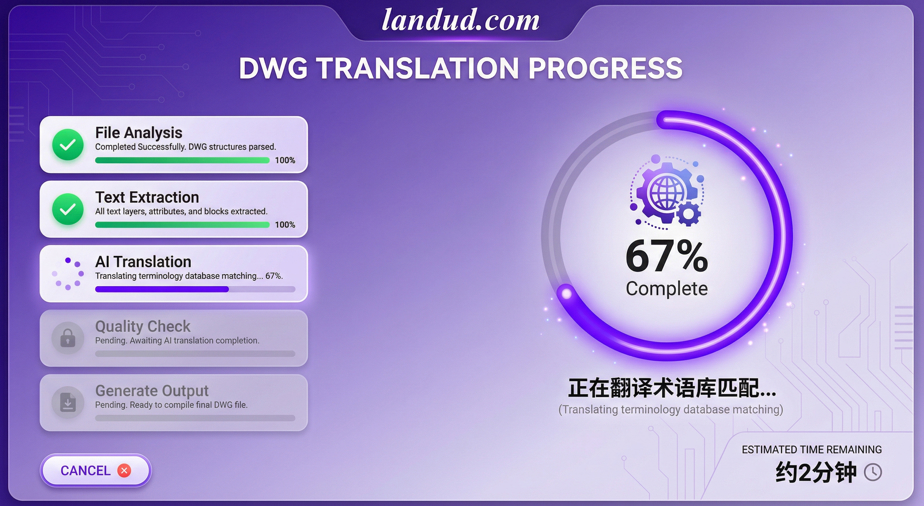
The operation process of using the AI intelligent translation platform is incredibly simple. You only need three steps: first, upload the CAD drawing file (supporting DWG and DXF formats) that needs to be translated to the platform; second, select the source and target languages from the dropdown menu; finally, click the "Start Translation" button, and then you can go have a cup of coffee. The entire process is fully automated, and the AI system will intelligently recognize all text content in the drawing, including single-line text, multi-line text, attribute text, block definition text, table text, annotation text, etc., without any manual selection or settings.
- 📤Smart Upload: Supports batch uploading of multiple DWG and DXF files, with a maximum size of 500MB per file
- 🎯Accurate Recognition: 100% coverage of all text types in CAD, including complex nested blocks and dynamic blocks
- 🌍Multilingual Support: Supports translation between 50+ languages, covering major global markets
- 💎Lossless Translation: Fully retains the original drawing's format, layers, line types, colors, and all attributes
- ⚡High-Speed Processing: The average translation time for a complex A1-sized drawing is no more than 3 minutes
🎯 The Secret of 100% Text Coverage
One of the most frustrating issues with traditional CAD translation plugins is text omission. You might translate 90% of the content, but the remaining 10% requires manual handling, which not only wastes time but also easily leads to translation inconsistencies. The AI intelligent translation system can accurately identify and extract all types of text objects by deeply learning the internal structure of CAD files.
This includes but is not limited to: ordinary single-line text (TEXT) and multi-line text (MTEXT), block attribute text (ATTRIB), text in block definitions, text in table cells, dimension annotation text, leader annotation text, and even hidden text in nested blocks and dynamic blocks. The AI system will recursively traverse the object tree of the entire drawing to ensure that no translatable text element is missed. More importantly, the translated text will precisely replace the original text, maintaining the same position, size, font style, rotation angle, and all visual attributes, making the translated drawing look as natural as the original design.
🌏 Multilingual Support: Breaking Language Barriers
In today's globalized world, an excellent CAD translation tool must support a wide range of languages. The AI translation platform currently supports translation between over 50 languages, covering more than 99% of the global architecture and engineering markets. This means that no matter where your project is located, you can easily complete localization translation work.
🗣️ Full Coverage of Mainstream Languages
For the most commonly used languages in the architectural engineering industry, the AI translation system provides top-notch translation quality. The translation accuracy for mainstream languages such as Chinese (Simplified and Traditional), English, Japanese, Korean, German, French, Spanish, Italian, Portuguese, and Russian has reached the level of professional translation. The system is equipped with a large database of architectural engineering terminology, enabling it to accurately understand and translate specialized terms such as "load-bearing wall," "shear wall," "distribution box," and "water supply and drainage system," avoiding common terminology errors found in generic translation tools.
🌐 Minor Languages Are No Longer a Barrier
Even more surprisingly, the AI translation platform also excels in supporting minor languages. Whether it's Southeast Asian languages like Vietnamese, Thai, Indonesian, and Malay, Middle Eastern languages like Arabic, Persian, and Turkish, or Eastern European languages like Polish, Czech, and Hungarian, high-quality translation services are available. This is a huge competitive advantage for companies looking to expand into emerging markets. I recently completed a drawing translation for a project in Vietnam, and the entire process took less than half an hour, whereas previously it might have taken a week to find suitable translation resources.
| Language Category | Supported Language Examples | Application Scenarios |
|---|---|---|
| East Asian Languages | Chinese, Japanese, Korean | China, Japan, and Korea architectural market projects |
| European Languages | English, German, French, Spanish, Italian | International cooperation projects in Europe and America |
| Southeast Asian Languages | Vietnamese, Thai, Indonesian, Malay | Southeast Asian infrastructure and real estate projects |
| Middle Eastern Languages | Arabic, Persian, Turkish | Middle Eastern oil and infrastructure projects |
| Other Languages | Russian, Portuguese, Hindi, etc. | Special projects in various regions worldwide |
🔧 Technical Advantages: Why AI Translation is Superior
From a technical perspective, AI-driven CAD translation has essential advantages over traditional methods. These advantages not only reflect in user experience but also fundamentally change the quality and efficiency of translation.
🧠 Improvement in Translation Quality through Deep Learning
The AI translation engine employs the latest neural machine translation (NMT) technology, which is a translation method based on deep learning. Unlike traditional rule-based or statistical translation methods, NMT can understand the overall semantics and context of sentences rather than simply translating word by word. This makes the translation results more natural, fluent, and accurate. Especially when dealing with specialized terminology in the architectural engineering field, the AI system can automatically select the most appropriate translation based on context, avoiding ambiguity and misunderstanding.
For example, the English word "column" may refer to "柱子" or "列" in different contexts, and traditional translation tools may not be able to distinguish between them, while the AI system can intelligently judge based on the drawing content. If this word appears in a structural drawing, it will be translated as "柱子"; if it appears in a table, it will be translated as "列". This contextual awareness greatly enhances the professionalism and accuracy of the translation.
☁️ Performance Advantages of Cloud Architecture
The cloud-based architecture allows the AI translation platform to have almost unlimited computing resources. When you upload a large CAD drawing, the cloud server automatically allocates resources for parallel processing, significantly shortening translation time. A complex drawing containing thousands of text objects may take 30 minutes or longer to process with traditional plugins, while on the AI platform, it usually only takes 2-3 minutes.
Moreover, the cloud architecture also means that the system can continuously learn and improve. Each translation task provides new training data for the AI model, ensuring that translation quality improves over time. Users do not need to manually update software or download patches to automatically enjoy the latest technological advancements. This "the more you use, the smarter it gets" feature is something traditional CAD translation plugins cannot compare to.
🔒 Data Security and Privacy Protection
Many users have concerns about the security of cloud translation, fearing that sensitive design drawings may be leaked. Excellent AI translation platforms adopt enterprise-level security measures to protect user data. All uploaded files are transmitted via SSL encryption, stored in data centers that meet international standards, and are automatically deleted after translation is completed. The platform also supports private cloud deployment, allowing large enterprises with special security requirements to deploy the entire translation system on their own servers, fully controlling data flow.
💼 Practical Application Scenarios: How AI Translation Changes Workflows
While theoretical advantages are important, the real reason I decided to give up traditional CAD translation plugins is the immense convenience brought by AI translation tools in practical work. Let me share a few real application scenarios.
🏗️ International Project Bidding
Last year, our company participated in a large commercial complex project bidding in Dubai. The bidding documents required all design drawings to be provided in both English and Arabic versions. According to previous practices, we needed to first export the Chinese drawings as PDFs, then hand them over to a translation company for processing, and finally have the designers manually re-enter the translated content into CAD. The entire process took at least a week and was prone to errors.
After using the AI translation platform, we completed the translation of all drawings in just one afternoon. We batch uploaded 120 DWG drawings, generating English and Arabic versions, and the translation quality fully met the bidding requirements. More importantly, the generated translated drawings retained all the formats and layouts of the original drawings, requiring no post-adjustments. This allowed us more time to focus on optimizing the design scheme, and we ultimately won the bid for this project.
📚 Localization of Technical Documents
Our company developed a standard drawing collection for prefabricated buildings that needs to be promoted to overseas markets. This collection includes over 200 detailed drawings and node samples, involving a large number of specialized terms and technical descriptions. If we used traditional methods for translation, it would not only be costly (estimated to exceed 100,000 yuan) but also take a long time (at least 2-3 months).
Through the AI translation tool, we completed the translations for English, Japanese, and Korean versions in just two days. Although technical personnel still need to review and fine-tune the specialized terms later, the workload has been reduced by over 90%. The total cost is less than one-tenth of the traditional method, and the translation quality meets publishing standards after review. This allows us to quickly enter the international market and seize opportunities.
🔄 Rapid Response to Design Changes
During project construction, design changes are common. For international projects, each change means needing to update the multilingual versions of the drawings. Previously, this was a very troublesome issue because re-translating took time and could delay construction progress.
Now, with the AI translation platform, design changes are no longer a problem. After designers modify the Chinese drawings, they can immediately upload them to the platform for translation and receive updated multilingual versions within minutes. This rapid response capability greatly enhances project management flexibility and increases client trust in us.
📊 Cost-Benefit Analysis: The Economic Value of AI Translation
From a business perspective, adopting AI translation tools not only improves efficiency but also brings significant cost savings. Let's do a simple comparative analysis.
💰 Direct Cost Comparison
The costs of using traditional CAD translation plugins include: AutoCAD software licenses (annual fee of about 5000-8000 yuan), plugin purchase fees (one-time or annual fee of about 2000-5000 yuan), and professional translation services (charged by word count, usually 100-300 yuan per thousand words). For a medium-sized project, translation costs alone can reach tens of thousands of yuan.
In contrast, the AI translation platform typically adopts a pay-as-you-go model, charging based on the number of drawings or text volume translated. Based on our company's actual usage, the average translation cost per project is less than 30% of traditional methods. When considering savings on software licensing fees and labor costs, overall cost savings can reach 50-70%.
⏰ The Hidden Value of Time Costs
Time is money, and this is especially evident in the construction engineering industry. Traditional translation methods may take days or even weeks to complete the translation of a project's drawings, while AI translation usually only takes a few hours. This time savings translates into significant economic value.
Faster translation speeds mean shorter project cycles, allowing for earlier delivery of results and quicker payment collection. For bidding projects, rapid translation capabilities enable us to participate in more bidding opportunities, increasing our winning rate. From this perspective, AI translation tools are not only a means of cost savings but also a powerful tool for generating revenue.
👥 Optimized Allocation of Human Resources
Before adopting AI translation, our company needed to assign a dedicated employee to coordinate drawing translation work, including communication with translation companies, checking translation quality, and handling file formats. Although this position was necessary, it did not directly create value.
Now, this employee has been reassigned to a more important design position, while translation work is completed by each project team. This optimization of human resources not only improves overall efficiency but also enhances employee job satisfaction. Designers no longer need to wait for translation results and can take more control over project progress.
🚀 Future Outlook: Trends in AI Translation Development
AI-driven CAD translation technology is still rapidly evolving, and there will be more exciting features and application scenarios in the future.
🤖 Smarter Context Understanding
Future AI translation systems will not only translate text but also understand the overall design intent of the drawings. For example, the system will be able to identify whether this is a structural drawing or an architectural drawing, whether it is a floor plan or an elevation, and thus choose more appropriate specialized terminology. It may even automatically adjust translation styles and wording habits based on project types (residential, office, industrial, etc.).
🔗 Deep Integration with BIM Platforms
With the popularization of BIM (Building Information Modeling) technology, AI translation tools are also integrating with BIM platforms. In the future, you may be able to directly call translation functions within BIM software like Revit and ArchiCAD, achieving one-click translation of all text information in 3D models. This will further simplify workflows and improve the efficiency of international dissemination of architectural information.
🎯 Personalized Customization and Terminology Management
Every enterprise and every project has its own specialized terminology and translation preferences. Future AI translation platforms will support enterprise-level terminology database management, allowing users to customize translation rules for specialized vocabulary and establish their own translation standards. The system will learn from the enterprise's historical translation data, continuously optimizing translation quality to better meet the specific needs of the enterprise.
🎉 Experience the Powerful Features of AI Translation Now
Say goodbye to cumbersome traditional methods and embrace the intelligent and efficient AI translation tool. No installation, no waiting, and you can complete professional CAD drawing translations in just a few minutes. Supporting 50+ languages, 100% text coverage, and lossless quality assurance.
Start your intelligent translation journey now!
✍️ Conclusion: Embrace Change and Enhance Competitiveness
Reflecting on my experience using the AI translation tool over the past year, I deeply appreciate the revolutionary impact of technological advancements on work methods. Giving up traditional CAD translation plugins is not just a simple tool replacement, but a shift in mindset. We are no longer constrained by technology; instead, we use technology to liberate productivity, allowing designers more time to focus on creative work.
For colleagues still using traditional translation methods, I strongly recommend trying the AI-driven intelligent translation platform. You may have concerns at first about translation quality, data security, and other issues, but once you truly experience it, you will find those worries unnecessary. The progress of technology is meant to serve humanity, not replace it. AI translation frees us from tedious repetitive tasks, allowing us to invest more energy into truly creative work that requires human intelligence.
In today's increasingly competitive global landscape, those who can complete drawing translations and project localization faster, better, and more economically will gain an advantage in the international market. AI translation technology is not just a tool; it is a strategic weapon for enhancing corporate competitiveness. In 2026, I chose to embrace this change; what about you?
Keywords:CAD translation | DWG translation | AutoCAD translation plugin | AI translation tool | drawing translation | DXF translation | CAD intelligent translation | AI-driven translation